
TIRCIA · E-book · English
Trauma explained
what happens in the mind and body, and what helps
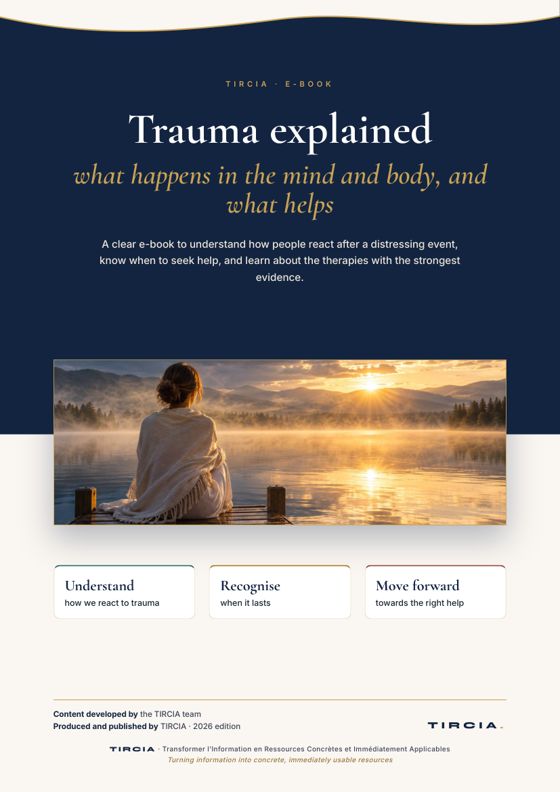
A clear e-book on what research currently tells us about trauma: how people react after a distressing event, when reactions last, and which therapies have the strongest evidence. It helps you make sense of what you feel and know where to turn.
01 · Who it is for
For anyone who wants to make sense of what happened
For people who have lived through a distressing event, recently or long ago, and for those close to them. It explains in plain words type I, type II and complex trauma, PTSD, complex PTSD and dissociation.
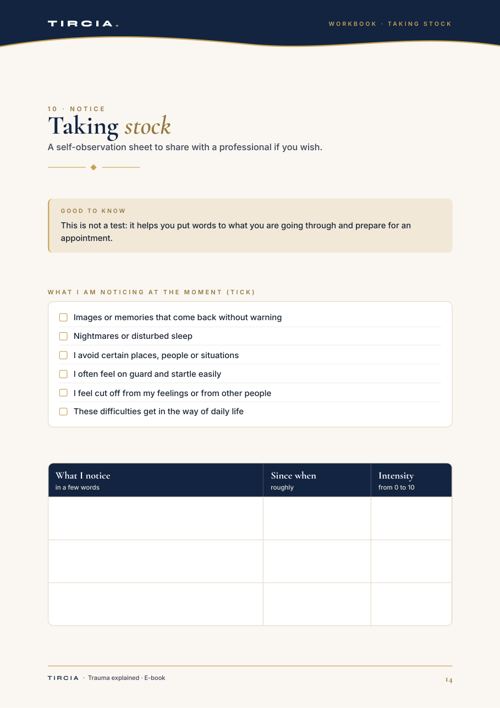
It also brings what helps in the first weeks, questions to ask a professional and a self-observation sheet to prepare an appointment. Doctors and therapists can hand it to the people they see.
02 · Inside the e-book
Nine short chapters, from understanding to help
What is trauma?
An event, and what it leaves behind: single, repeated and complex trauma.
More common than you might think
What large international surveys show about trauma and recovery.
How people react after an event
Common reactions in body, feelings, thoughts and sleep, and what helps early on.
When it lasts: post-traumatic stress
Re-experiencing, avoidance and sense of threat, as described in ICD-11.
Complex post-traumatic stress
When repeated trauma also affects emotions, sense of self and relationships.
The brain’s alarm system
The alarm, the archivist and the conductor: a simplified model.
When the mind steps back
Dissociation in simple terms, as a protective reaction.
What helps: recommended therapies
Trauma-focused CBT, cognitive processing therapy, prolonged exposure and EMDR.
Finding help
Who to turn to, and questions to ask a professional.
03 · A look inside
Clear, airy pages, made to be read slowly


Good to know
This e-book offers bearings and goes alongside the care of a doctor or therapist; it does not provide a diagnosis. If you are in danger or in severe distress, call your local emergency number: 112 in Europe, 999 in the UK, 911 in the US. If you are having thoughts of suicide: Samaritans 116 123 (UK and Ireland, free, 24/7) or the 988 Suicide & Crisis Lifeline (US).
Read it a section at a time, and keep it close
Also available in French: Comprendre le trauma
Editorial direction: Marie-Agnès ThulliezTIRCIA
Turning information into concrete, immediately usable resources